When you watch Squid Game Season 3 you can see the root of When you watch Squid Game Season 3 you can see the root of South Korea’s ultra-low birth-rate.
South Korea’s ultra-low birth-rate.
사회 사회 written in 2025.06.30.
translated in 2025.11.12. helped by chatGPT When you watch Squid Game Season 3 you can see the root of South Korea’s ultra-low birth-rate.
Jiyong Iruon Park, M.D.
– A weak story built by 586(50’s-men) leads to a poor ending.
– The contrast between the disappointment of the 20-30s generation and the “well done anyway” praise of the 40-50s generation.
Order of topics: 1. <The suited men shouting democracy are actually supporters of Park Chung-hee (Korean dictator)> 2. <The son abandoned even by his mother, the incel> 3. <The incompetent 20-30s disregarding the elder’s advice, Detective Hwang> 4. <Among 20-30s men there are only cruel perpetrators or pathetic victims> 5. <The baby’s arrival is the director’s inevitable device to deal with low birth-rate in Squid Game> 6. <Stupid and failed Seong Gi-hun is the self-mocking character of the 586 generation> 7. <A storyline that misses both entertainment and social satire> 8. <For Squid Game’s social critique to resonate, this way was required> 9. <Who in the end leads the majority rule in South Korea? It is the 586-generation just like the director> * 586(O-pal-yuk) means Korean people 50′ in their age, 80′ entered univ, 60′ when they were born – who are high in their education, againt dictatorship and social involving(usually left wing), but not know enough about current issue.
Squid Game is a drama full of social messages. In Season 2 the side that wins the election took all decision- making power, leading to extreme polarization between left and right. In Season 3 the elegantly-suit-clad men shouting democracy use majority rule as the decisive justification for their crude decisions.
When viewers find themselves thinking “Why did they bother to include that scene?”, most of those scenes intend to depict South Korea’s social problems. If you want to understand why seemingly incomprehensible elements are included in the drama, think from the perspective of the 586-generation. This text organises those aspects.
1. <The suited men shouting democracy are actually supporters of Park Chung-hee (Korean dictator)>
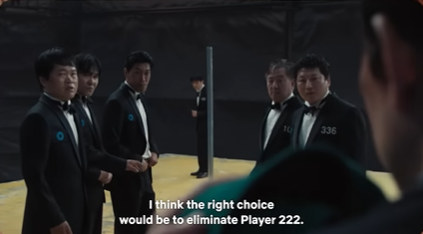
The men in the photo are all from the privileged older age group.
Since we cannot capture screenshots from Netflix, the image is taken from a foreign YouTuber’s video.
the men shouting democracy in Squid Game do not symbolise supporters of the Democratic Party; rather they symbolise the 60-70s right-wing who nostalgically remember the Park Chung-hee era. For the 586s, the trauma of losing multiple presidential elections to older-generation voters until the time of President Moon Jae-in(democratic party, 2017-2022) was elected.
Since Roh Tae-woo (1988-1993, the first president elected after democratiziation, but the right-hand man of former president Chun Doo-hwan the following dictator after Park)
through Park Geun-hye(daughter of dictator-president Park) the left has almost never beaten the right one- on-one in elections. Kim Dae-jung(1998-2003, democratic party) won against Lee Hoi-chang and Lee In-je with only about 40% of the vote. Roh Moo-hyun(2003-2007, democratic party) was dominated through most of the campaign by Lee Hoi-chang and achieved a narrow win at the end. Although the 20-30-40s supported the Democratic Party, the 60s and older’s strength was so great.
Subsequent victories of the conservative party under Lee Myung-bak(2008-2013, conservative party) and Park Geun-hye(2014-2018, daughter of president Park, conservative party) made the 40-50s develop skepticism toward democracy. Considering the Internet’s “guk-gae-ron” (all real cause of the political problems are Korean people who elect Korean politicians not just bad politicians. Gukmin-Gaesaeki-Theory)
that circulated before the rise of the far-right community(Ilbe, you can think of 4chan), one can understand how deeply negative the perception of majority-rule elections was among the 586-generation.
2. <The son abandoned even by his mother, the incel> The scene that nearly everyone marks as hardest to understand in Squid Game 3 is the mother (Geum-ja)
killing her son (Yang Dong-geun actor) to save the mother of the child born only minutes ago.
The mother enters the game to pay off her son’s gambling debt; the son is incompetent, cannot even scold others, is depicted as unable to live for himself, let alone his mother. In the game’s structure his mother’s rescue is never achieved; he is busy just living himself.

A useless man who cannot even work his own misdeeds into a living wage. An archetypal incel.
In his final scene he is in a situation where to survive he must kill someone. He tries to kill the young mother next to his own mother. But the mother blocks him, stabbing him with her hairpin to protect the baby- mother. As a result he is eliminated from the game and dies.
No matter how the baby-mother had just given birth, was that enough value for a mother to kill her son with whom she had lived for decades? After all, the original reason she joined the game was to save him. Both Korean and international viewers cited this part as the most difficult to empathise with.
But from the ‘586-generation’ perspective the mother’s action makes sense: in their view, the net-right (internet-right conservatives) who oppose progressive parties and act like incels deserve to die.
3. <The incompetent 20-30s disregarding the elder’s advice, Detective Hwang> One of the two story-threads outside the games is the island search. Detective Hwang burns with the desire to find his brother, and wastes two years trying to locate the island where the Squid Game takes place.
But the answer was not hidden in difficulty. On the behalf of Seong Gi-hun, Choi Woo-seok searched the captain’s house and found the captain’s identity in just two days.

Detective Hwang, a 30-something man, repeatedly dismisses Choi Woo-seok’s accurate suspicions, saying “Don’t speak nonsense.”
Ultimately, the captain whom Hwang trusted is revealed to be a traitor and kills Hwang’s whole team.
Many viewers wonder why Detective Hwang’s storyline even exists. He never affects what happens in the games; his only outcomes are finding his brother in the end and caring for the baby of the second game winner.
In the end, there is only a message from Hwang’s story: A brash 20-30-something man who ignores advice from his elder (Choi Woo-seok) ends up messing everything up.
The “finding-island” scene is a sharp criticism by older 50+ men aimed at younger men (in their 20s-30s)
whose support for Lee Jae-myung(SK’s president, 2025~, democratic party) was at its lowest.
4. <Only vicious perpetrators or pathetic victims among 20-30 s men> Although players in the game are all in dire straits, among female characters there are many positive roles: the pregnant woman Jun-hee, the addict-turn-redeemed Se-mi, the steadily-trying to end-the-game Young- mi, the transgender Hyun-ju.
But among 20-30s male characters there is no good role. The addict Thanos and Nam-gyu of course, the bullied Min-soo becomes drug-addicted after the disappearance of Se-mi who cared for him. Unlike Korea’s general orientation of weak-good-strong-bad, the drug-addicted and meaningless death of Minsoo was particularly hard to empathise with. (But to those who already consider 20-30s men inherently bad, it was natural to see both the strong and the weak among them as bad.)

All young men are villains in Squid game 3 The crypto-YouTuber Myung-gi represents the peak of the 586-generation’s hatred for 20-30s men — incompetent, making money in crypto, chasing young women, selfishly killing the baby at the end to save himself. He stands in sharp contrast to Seong Gi-hun, who tries everything for the baby.
The scene where Myung-gi asks Jun-hee “what relation do you have with Seong Gi-hun?” while jealous of him and interrogating him—this was the climax of how 586s view 20-30-male employees and the young female workers.

“’Did something happen between you two ?’ — Myung-gi presses Seong Gi-hun about his relationship with Jun-hee. It stands in contrast to posts by 20-30-year- old male office workers, who complain that middle-aged male seniors at their workplace give benefits out of nowhere to 20-30-year-old women.”
In the final game, Im Si-wan could have escaped the game with the baby after killing Seong Gi-hun. Yet, in that situation he still chooses to kill both Seong Gi-hun and his own baby: he hands over only the baby (who needs to be killed in the next stage) to Seong Gi-hun, and demands Seong Gi-hun not advance to the next stage. Who other than the 586-generation in Korea could empathise with this scene?
5. <The baby’s arrival is the director’s inevitable device to deal with low birth-rate in Squid Game> The moment the baby is born the outcome of the game is already determined; many say the plot became clichéd. Because in global sensibility a baby being murdered in a drama is unthinkable.
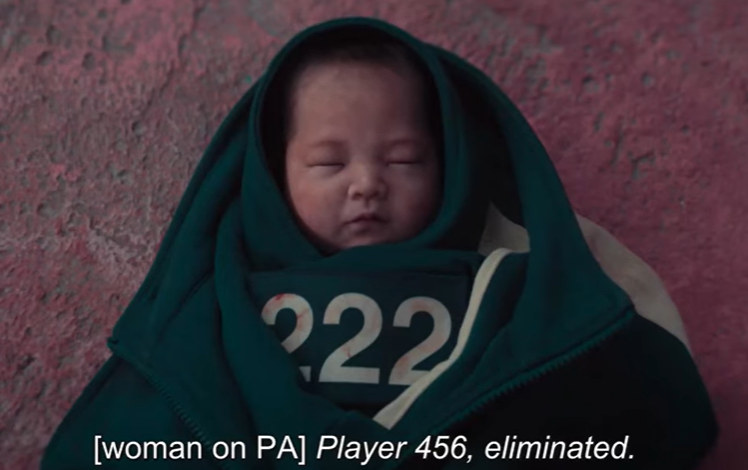
The baby surviving to the end was a foregone conclusion Story-wise the baby should not have appeared; but for director Hwang Dong-hyuk it was absolutely necessary. Because he wanted to address a universal yet Korean-specific social problem.
From the start, Squid Game handled children’s games that Korean kids used to play, which is part of why it became a huge hit. Also in the story, ‘Geum-ja’ has a son who keeps bringing up the Korean War, and the O/ X voting gets repeated to show extreme political division. You can clearly see the director’s intention to deal with social issues. For that director, Korea’s ultra-low birth-rate was a key topic he didn’t want to miss. the start, Squid Game used children’s games enjoyed in Korea and repeated OX voting to show extreme political confrontation; this director could not miss Korea’s low birth-rate as a core theme.
In that director’s logic the baby-mother Jun-hee must be an absolute good; the incel must be so bad that even the mother kills him; birth-rate must be guarded at all cost.
From the director’s perspective, the mother Jun-hee—having given birth—must represent absolute good; the incel who harms her must be killed even by his own mother; because the birth-rate is a value that must be protected at all costs.
Also the 45.6 billion-won prize all goes to the newborn baby—that scene evokes the idea of childbirth incentives: you can spend any huge amount because it’s not wasted.
6. <Stupid and failed Seong Gi-hun is the self-mocking character of the 586 generation> The director seems to view the games as a system of popular rule, or if you like as capitalism or free-market system. The winner takes all prize structure evokes that capitalism. (not sure this translation is correct, but the key is, the director seems to tried to satire capitalism)
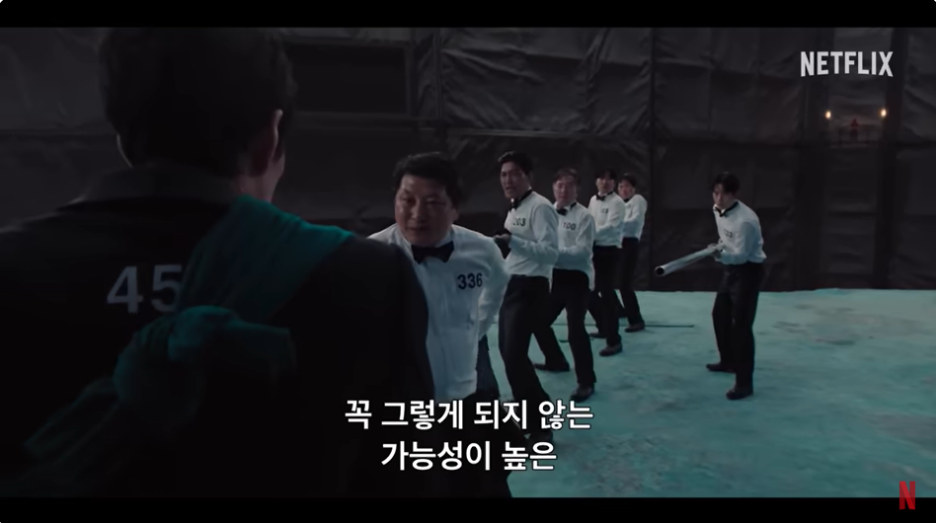
It somewhat feels like a contrast between the 60-year-olds who support the conservative party and the young men in their 20s who back Lee Jun-seok, standing opposed to the 586-generation.
In that view Seong Gi-hun — though somewhat reckless — rises up against the system that forced the participants to sacrifice themselves, and ultimately survives within the system after his rebellion fails.
Meanwhile, the ‘good’ rebel (X) is gone, and the group (O) that supports the system now dominates society.
The director acknowledges that Gi-hun sought justice, but failed to bring about real change — much like many 586-generation office workers who tried to overturn the system and then ended up conforming.
But the 586-generation still has a final epochal task: solving the ultra-low birth-rate. To address South Korea’s greatest social problem, they decide to help pregnant women, shut down the bad 20-30s men who threaten babies, and finally—even sacrifice themselves (with daughters) to save the baby (= to solve the low-birth-rate issue). The protagonist-generation’s truly… great (?) decision.
7. <A storyline that misses both entertainment and social satire> < 오락과 사회풍자 둘 다 놓친 전개 > There are highly praised scenes in Squid Game 3: the “What do you think? I’m playing” line in the jump-rope and the “lunchbox” line in the final one-death-per-stage game.

Now all we need to do is carry it over there. Huh?
(direct translation : packaging done guys~ (in polite expression))
Scenes where competitors are removed by any means necessary, creating unjust victims yet proceeding strictly within the rules, thrilled viewers. These sequences carried no overt social message—but they were closest to the essence of the game and received strong audience response.
Outside those game-scenes, however, the story was heavily laden with social messaging from the 586-generation’s viewpoint, and the psychology of the characters was hardly relatable: a mother killing her own son to save someone else’s baby; a bullied outcast spending years suffering only to descend into drug addiction and fall off without any dramatic reversal; a 30-something detective repeating his incompetence until his role simply ends.
8. <For Squid Game’s social critique to resonate, this way was required> < 오징어 게임의 사회비판이 호응을 받기 위해선 이래야했다 > Korean society for a long time has pushed feminism as the solution to low birth-rate (gas-lighting). 20s may find this hard to understand, but 30s and above will all empathise: the idea that women-friendly policies will raise birth-rate is widely spread.
So the director continuously depicted Seong Gi-hun in a woman-favouring posture, and in the final scene he sacrifices himself for someone else’s baby as if it were a meaningful act to resolve low birth-rate.
But the reality experienced by young Koreans is different: feminists who are hostile to child-birth and trans- issues, male median-income earners unable to expect dating-marriage-childcare, apartment prices too high to make savings meaningful, 20-30s male workers in despair.
If the director really wanted to deliver a social message properly he should have depicted those scenes, not the middle-aged man sacrificing himself for a baby. If he couldn’t do that he should have focused on the game scenes like the “I’m playing” and “lunchbox” lines, but his mistake was inserting many half-hearted 586-style social messages.
9. <Who in the end leads the majority rule in South Korea? It is the 586-generation just like the director> The core societal message symbolised by the baby that wins the 45.6 billion-won prize is ultimately South Korea’s low birth-rate.
The problem is that the 586-generation director’s depiction of this problem treats both causes and solutions in the typical terms of the 586-progressive-party-supporter line. They cannot diagnose properly, they demonise the incel young men who disagree, and they adopt the 586-generation’s own view of the world.
At some point the idea of solving low birth-rate was abandoned; a view emerged that perhaps low birth-rate might even be beneficial. The reason: the belief that the problem is unsolvable.
I personally studied feminism dismantling and believed that once feminism is properly deconstructed Korea’s low birth-rate problem can be solved.

김포 마디척병원에서 척추 질환과 통증을 진료하고 있습니다.
UBE 내시경 척추수술을 비롯해 척추융합술, 경추 인공디스크 수술, 척추성형술과 신경성형술 등 경추·요추 질환의 다양한 수술과 시술을 시행하고 있습니다.
허리·목 통증과 척추 질환은 정형외과와 신경외과 모두에서 진료하는 분야로, 저는 신경외과 전문의로서 척추 질환을 중심으로 진료하고 있습니다.
이대목동병원 신경외과에서 전공의 과정을 마친 뒤, 우리들병원에서 전임의로 근무하며 척추 분야를 전문적으로 수련했습니다.
All posts on this site are written by Jiyong Iruon Park.